FACTS
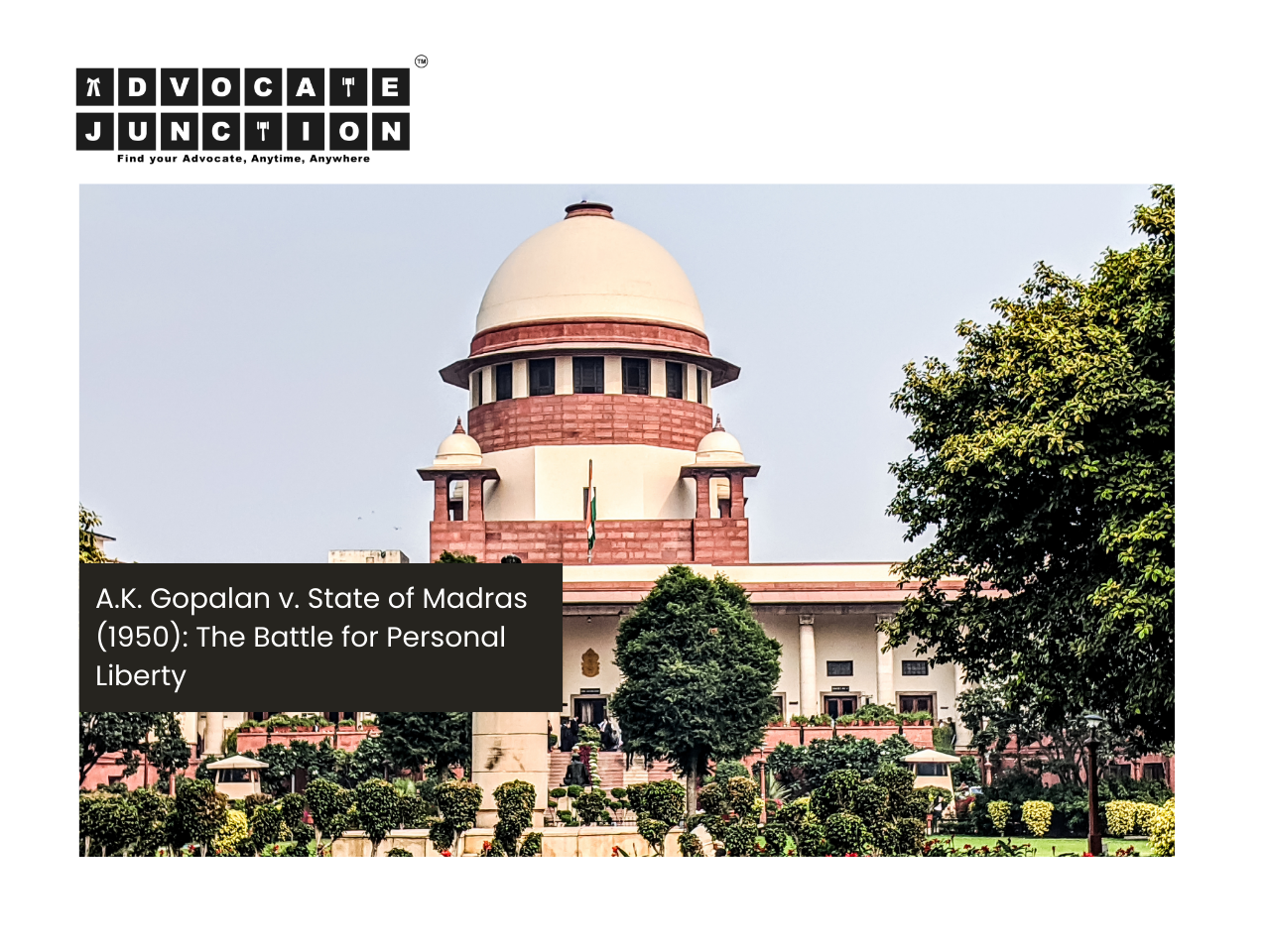
The petitioner, A.K. Gopalan, was detained under the Preventive Detention Act, 1950 (Act IV of 1950), a legislation designed to preventively detain individuals on the grounds of suspicion to avert potential criminal activities. Unlike punitive detention, which follows an offense, preventive detention serves as a preemptive measure to restrict individuals deemed a potential threat to public order or national security.
Challenging his detention, the petitioner filed a writ petition under Article 32 of the Constitution, arguing that the Preventive Detention Act contravened his fundamental rights enshrined in Articles 13, 19, 21, and 22 of the Constitution, rendering the law ultra vires and his detention illegal.
QUESTIONS OF LAW
The case primarily examined whether the Preventive Detention Act, 1950, violated the fundamental rights guaranteed under:
- Article 13: Laws inconsistent with or in derogation of fundamental rights
- Article 19: Right to freedom
- Article 21: Right to life and personal liberty
- Article 22: Protection against arbitrary arrest and detention
HELD
The Supreme Court upheld the validity of the Preventive Detention Act, ruling that:
- Article 19 and Preventive Detention: The Court held that the right to freedom under Article 19 does not apply to cases of preventive detention. It stated that Article 19 is meant for ordinary laws restricting freedoms, not for detention under a special law.
- Separation of Articles 19 and 21: The Court took a strict textual approach and ruled that Articles 19 and 21 operate independently. While Article 19 grants specific freedoms to citizens, Article 21 extends the right to life and personal liberty to all persons. Thus, a law affecting personal liberty under Article 21 need not necessarily comply with the tests of reasonableness under Article 19.
- Interpretation of Article 21: The Court distinguished the phrase “procedure established by law” in Article 21 from the American concept of “due process of law.” It concluded that as long as a law is duly enacted by a competent legislature, it satisfies the requirement of Article 21, even if it lacks procedural safeguards or principles of natural justice.
- Article 22 and Legislative Power: Article 22 explicitly grants Parliament the authority to enact laws on preventive detention. Clauses (4) to (7) impose certain limitations on such laws, ensuring that procedural safeguards exist, such as the requirement of an advisory board to review detentions beyond three months. As long as preventive detention laws comply with these limitations, they remain constitutionally valid.
- Conclusion: The Court held that Articles 19, 21, and 22 are mutually exclusive. A law affecting life and personal liberty cannot be struck down merely because it lacks procedural fairness or natural justice. The ruling reinforced the idea that Article 21 does not provide protection against legislative actions that are duly enacted.
Significance of the Judgment
The decision in A.K. Gopalan v. State of Madras set a precedent for a strict interpretation of fundamental rights, particularly Articles 19 and 21. It upheld legislative supremacy in matters concerning preventive detention and endorsed a restrictive reading of the right to personal liberty. However, this interpretation was later reconsidered in Maneka Gandhi v. Union of India (1978), where the Court adopted a more expansive and rights-oriented approach, linking Articles 14, 19, and 21.
This landmark case remains a crucial part of constitutional jurisprudence, shaping the evolution of fundamental rights in India.